
Looking for a paper trading simulator? Learn where to practice paper trading, which apps are free, and how to start paper trading and use simulators to actually improve.
This guide explains where to practice paper trading and how to actually learn from it.
Table of Contents
- 1 What Is a Paper Trading Simulator?
- 2 In Where App Can I Practice Paper Trading?
- 3 Is There a Simulator for Trading That Feels Real?
- 4 What Is the Best App for Paper Trading?
- 5 Why Most Traders Fail Even With a Paper Trading Simulator
- 6 How to Use a Paper Trading Simulator the Right Way
- 7 Paper Trading vs Backtesting: Key Differences
- 8 A Simulator Is Just the Starting Point
- 9 Summary of frequently asked questions
What Is a Paper Trading Simulator?
A paper trading simulator is a tool that allows traders to practice buying and selling financial instruments using virtual money instead of real capital.
It replicates real market conditions using live or delayed data, helping traders:
- Learn order execution
- Test strategies
- Practice risk management
- Build confidence without financial risk
In Where App Can I Practice Paper Trading?
You can practice paper trading on several reputable apps & platforms that offer built-in simulators or demo accounts.
Popular Paper Trading Simulators
- TradingView – Paper trading directly on charts, ideal for technical analysis
- Interactive Brokers (IBKR) – Highly realistic simulator for advanced traders
- thinkorswim (Charles Schwab) – Strong tools for options and futures
- Webull – Beginner-friendly mobile-focused paper trading app
Each platform offers a different balance between realism, ease of use, and asset coverage.
Is There a Simulator for Trading That Feels Real?
Yes, but realism varies significantly between platforms.
What Makes a Trading Simulator “Realistic”?
- Live or near-real-time market data
- Order types (market, limit, stop-loss)
- Session-based market behavior
- Slippage and execution rules
Most free paper trading simulators simplify execution, which can lead to overly optimistic results.
This is why simulator results should always be validated through structured analysis, not just P&L.
What Is the Best App for Paper Trading?
There is no single “best” paper trading app, it depends on what you trade and how you learn.
Choosing the right paper trading simulator depends on your strategy, asset class, and experience level.
Best for chart-based trading: Trading View
TradingView stands out for its advanced and customizable charts, with access to multiple technical indicators, drawing tools, and timeframes.
Its paper trading simulator is integrated directly into the chart, allowing traders to visually practice entries and exits, evaluate key levels, and refine their technical analysis without switching platforms.
Best for execution realism: Interactive Brokers
Interactive Brokers offers a simulation that most closely resembles the real trading experience in terms of order execution, complex order types, and real-time market data.
This makes it the best option if you need to practice advanced orders, slippage management, and real market conditions, ideal for serious traders planning to migrate to professional live accounts.
Best for beginners: Webull
Webull stands out for its intuitive interface and ease of use, making it ideal for traders who are just starting out.
Its simplified format helps new traders focus on the basics of execution without being overwhelmed by too many advanced features from the outset.
Best for options & futures: thinkorswim
thinkorswim is a powerful platform with paperMoney simulation focused on complex derivatives such as options and futures.
It offers specific analysis for options strategies, spreads, volatility, and sophisticated backtesting tools, making it preferred by those who trade derivative markets that require more depth than a simple stock simulator.
If you want, I can also give you a comparative version in table format or a longer description for each platform ready to use on your blog or landing page.
Why Most Traders Fail Even With a Paper Trading Simulator
Paper trading alone doesn’t create profitable traders.
Most failures happen because traders:
- Don’t record their trades
- Don’t track win rate or risk–reward
- Don’t compare strategies or setups
- Rely on memory instead of data
This is where paper trading must evolve into structured backtesting.
How to Use a Paper Trading Simulator the Right Way
1) Treat virtual money as real capital
Set a realistic starting balance.
Follow the same rules you would with real money.
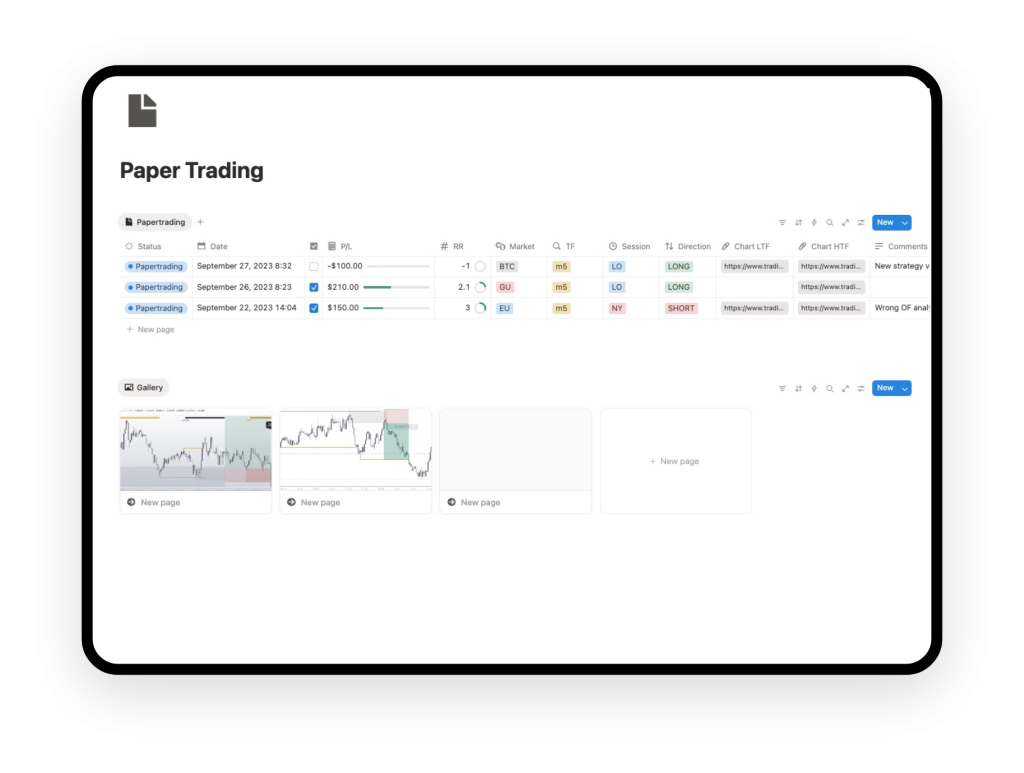
2) Log every trade you take
After each paper trade, record:
- Entry and exit logic
- Risk–reward (RR)
- Session and timeframe
- Win or loss outcome
Without documentation, paper trading has limited value.
3) Analyze performance across multiple trades
Instead of focusing on individual wins:
- Track win rate
- Measure RR consistency
- Compare setups objectively
This is backtesting trading strategies, even if trades were simulated.
Paper Trading vs Backtesting: Key Differences
| Feature | Paper Trading | Backtesting |
|---|---|---|
| Capital | Virtual money | Historical or simulated |
| Focus | Execution practice | Strategy validation |
| Psychology | Low | None |
| Data analysis | Minimal | Statistical |
| Goal | Learn mechanics | Prove edge |
A Simulator Is Just the Starting Point
A paper trading simulator helps you practice — but practice without analysis leads nowhere.
To actually improve:
- Practice trades in a simulator
- Document every decision
- Analyze results systematically
- Refine or discard strategies based on data
That’s how paper trading becomes preparation for real trading.
👉 Explore the Trading Studio (Notion Template) and turn paper trades into validated strategies.
Summary of frequently asked questions
Can I do paper trading for free?
Yes, many platforms offer free paper trading accounts, including TradingView, Webull, and thinkorswim. These accounts let you practice trading with virtual money, but execution and market conditions may be simplified compared to live trading.
Is there a simulator for trading?
Yes, trading simulators allow you to practice buying and selling financial instruments using virtual funds. Most simulators use real or delayed market data and are designed to help traders learn execution and test strategies without risking real money.
Where can I practice paper trading?
You can practice paper trading on platforms like TradingView, Interactive Brokers, thinkorswim (Charles Schwab), and Webull. Each platform offers different levels of realism, asset coverage, and trading tools.
What is the best app for paper trading?
The best paper trading app depends on what you trade and your experience level. TradingView is ideal for chart-based trading, Interactive Brokers offers the most realistic execution, Webull is beginner-friendly, and thinkorswim is well suited for options and futures.

